We are never paid for a review. We sell several of the cleaners and brushes on this page on our store and say so each time; some other links on this site earn ShopCoffee a small commission at no cost to you. Details
● Written from the makers' own instructions and the listings on our store, November 15, 2026Doses and prices move — tell us if something here is stale
Where the numbers come from
What this is: a schedule. Every interval and dose is quoted from the maker's own page or manual, read on November 15, 2026: Baratza's grinder cleaning guide (baratza.com), Urnex's product pages for Grindz and Cafiza (urnex.com), Bonavita's manual for the BV1900TS brewer (read in the copy on manualslib.com), and the supplier's listings on our store for the Urnex Tabz, Puro and Pällo products.
What this is not: a test. We have not cleaned machines side by side or tasted before and after, and nothing here says one cleaner works better than another.
Your manual outranks this page. Makers differ on what may be washed, backflushed or descaled, and a warranty follows the manual. Where your manual and this chart disagree, the manual is right.
Contents
The schedule
Find the job in the first column. The interval and the dose are the maker's, and the fourth column says which maker.
| Job | How often | With what, and how much | Whose number | On our store (November 15, 2026) |
|---|---|---|---|---|
| Grinder: brush out the burrs and chute, wash the hopper and bin | Every 4–6 weeks; more often with dark roasts | A grinder brush; warm soapy water for the hopper and grounds bin only, dried thoroughly | Baratza | Grinder brush, $7.99 |
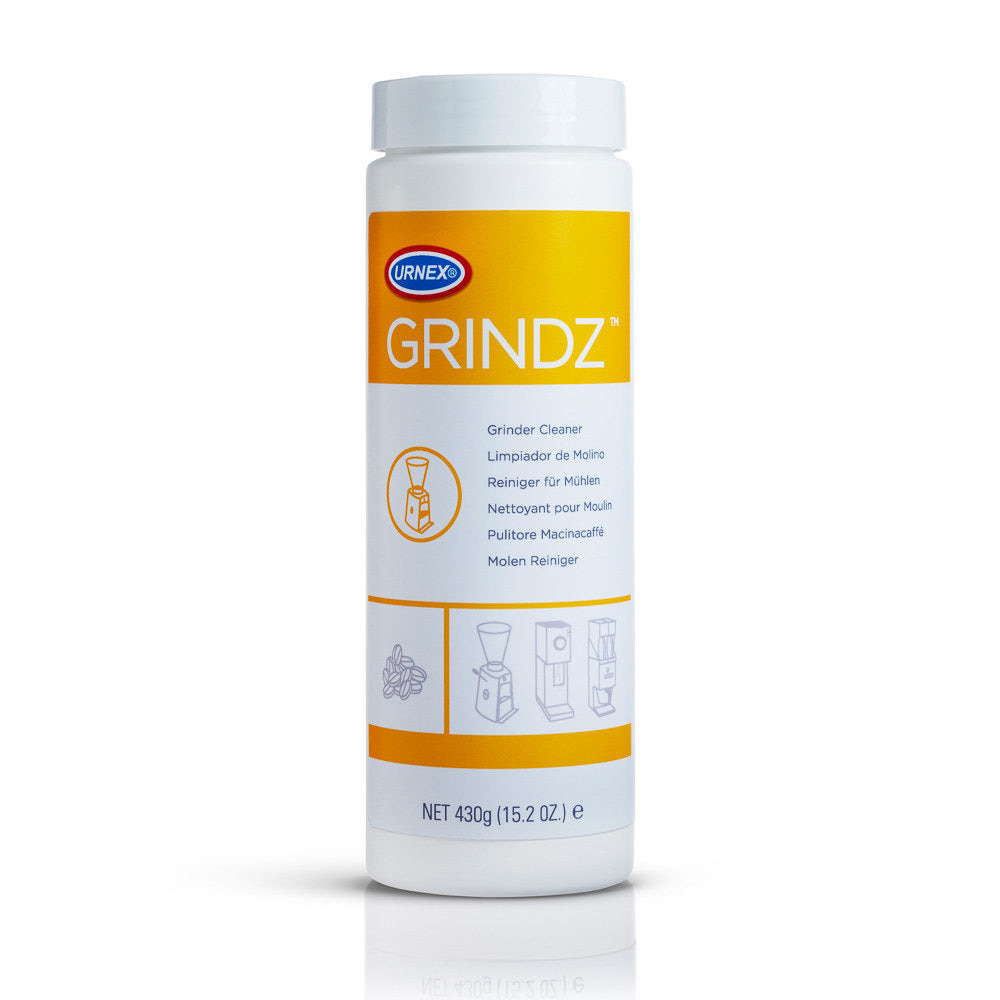
| Grinder: cleaning tablets (optional; “highly recommended” for dark roasts) | With the routine clean | Grindz: 1 jar cap (35–40 g), then the same of coffee to purge | Baratza (when); Urnex (dose) | Grindz 430 g, $20 |
| Drip brewer: coffee oils in the basket and carafe | Not stated by the maker; see below | 1 Tabz tablet per 64 oz (2 L) of carafe, through a brew cycle, soak, rinse | Supplier listing (Urnex Tabz) | Tabz, 120 tablets, $10.95 |
| Drip brewer: descale | Every 100 brew cycles, or once every three months | A descaling powder: 1 packet in 32 oz of lukewarm water, brew, then two rinses with fresh cold water | Bonavita (BV1900TS manual) | Not stocked |
| Espresso machine: backflush (only if the manual allows it) | Not stated on the product page; see below | Up to 1/2 teaspoon (3 g) of powder in a blind filter; 10 s on, 10 s off, 5 times; repeat without powder | Urnex (Cafiza) | Puro, 1-gallon pail, $68 (café size) |
| Espresso machine: soak baskets and portafilter heads | With the backflush | 6 g of powder per litre of hot water, 30 minutes, rinse; keep the handle out | Urnex (Cafiza) | Same powder |
| Espresso machine: group head and steam wand | Not stated; see below | A group brush and a wand brush sized to the wand | Supplier listings | 58 mm group brush, $8.40 · wand brush, $5.50 |
“Not stated” means the maker's page gives a dose and no interval, and we have not invented one. “Not stocked” means we do not carry it today. The table scrolls sideways on a phone.
The short version: brush the grinder about once a month, descale the brewer about once a season, and never mix up the two kinds of cleaner.
Cleaning and descaling are two jobs
Coffee leaves oils and fine particles wherever it touches: burrs, brew basket, carafe, group head. Water leaves minerals wherever it is heated: the element and the tubes. They are different deposits and each product is made for one of them. A coffee-oil cleaner (Grindz, Tabz, Cafiza, Puro) does nothing for scale; a descaler does nothing for oils.
That is why the schedule has two rhythms. Cleaning follows how much coffee you make and how dark it is roasted. Descaling follows how much water you run and how hard that water is.
The grinder
Baratza, whose grinders are in our grinder guide, publishes the clearest routine we could find. From its cleaning guide, read November 15, 2026, under the heading “Routine Cleaning (Every 4–6 Weeks)”: “Remove hopper and upper burr”, “Grind through any remaining coffee, then brush out loose grounds and residue”, “Clean inside the burr chamber and chute”, “Wash hopper and grounds bin with warm soapy water and dry thoroughly”.
On roast, the same page: “Dark roasts: need cleaning more often due to the oils they leave in the grinder.” Its reason is practical: the oils can affect flavor and “significantly” raise the risk of a clog, “since coffee sticks to the oil”.
The last step in Baratza's routine is optional: “Grind some grinder cleaning tablets to absorb oils. This is highly recommended if grinding primarily dark roast coffee.” The tablets most shops mean are Urnex Grindz. Urnex's instructions, read on urnex.com the same day:
- “Empty all coffee from grinder.”
- “Add Grindz Grinder Cleaning Tablets – use 1 jar cap (35-40 g) for espresso grinders or 2 caps (70-80 g) for shop grinders.”
- “Adjust grinder to medium setting and operate.”
- “To purge, repeat steps 1-3 using coffee beans instead of Grindz.”
Two limits in Urnex's own words: “Do not use in superautomatic machine grinders”, and the purge is part of the instructions, so each cleaning also uses 35 to 40 g of coffee you will not drink. Urnex describes the tablets as formulated “from all natural, plant-based ingredients”.
On our store: Urnex Grindz, 430 g jar, $20 (ships from Espresso Parts; Urnex's own store listed the jar at $25.99 on November 15, 2026). The brush: the grinder brush with synthetic bristles, $7.99, or the Pällo GrindMinder 2.0, $14, which its listing describes as “both a grinder burr brush and a countertop brush”.
What the routine leaves out matters as much: water goes on the hopper and the grounds bin, and the routine sends nothing wet to the burrs. A hand grinder follows its own maker's instructions; our hand grinder guide lists them.
The drip brewer and carafe
The brown film inside a carafe and brew basket is coffee oil. Dish soap and a bottle brush handle a glass carafe; a thermal carafe with a narrow neck is where a tablet earns its place. The listing for Urnex Tabz on our store ($10.95 for 120 tablets) gives the method:
- “Place one TABZ tablet in the brew basket for every 64 oz (2 L) of vessel capacity.”
- “Run a full brew cycle, allowing the cleaning solution to fill the server. Pause to let it soak.”
- “Discard the cleaning solution and wipe away any remaining residue. Thoroughly rinse all components with clean water before brewing coffee again.”
The listing says the tablets carry “a blue safety dye to help ensure proper rinsing”: rinse until the water runs clear. Said plainly, the same listing calls Tabz “Built for Commercial Use”; the dose is by carafe size, so a home brewer with a carafe under 64 oz takes one tablet. Neither the listing nor any maker page we read gives an interval for this job, so we will not print one. The film is visible; clean it when you can see it.
For counters, hoppers and the outside of the machine, the listing for Urnex Café Wipz ($11.30 for 100) says “no rinse required” and “safe on steam wands, hoppers, counters”. It also says, and so do we, that they “are not disinfecting wipes”.
Descaling
Bonavita, whose brewers we sell, puts a number on it. From the manual for its BV1900TS 8-cup brewer, read November 15, 2026: “We suggest that you descale your brewer after every 100 brew cycles, or once every three months.” And sooner “if the appliance makes an unusually loud noise, delays brew time, or fails to achieve the proper water temperature of 195º-205ºF (91°-96°C)”.
The arithmetic makes the two halves of that sentence agree: one pot a day is 100 brews in a little over three months. Two pots a day, descale every seven weeks. A pot only on weekends, the three-month line arrives first.
On vinegar, the same manual: “Vinegar may not effectively descale your brewer, and can be difficult to rinse thoroughly”, and it “may also leave behind an odor that can impact the flavor of your coffee”. It names a descaling powder instead and gives the method as one packet mixed with 32 oz of lukewarm water, poured into the reservoir and brewed, then repeated twice with fresh, cold water. Other makers write other rules, some of them with a CLEAN light that tells you when; read yours.
We do not stock a descaler today. Urnex makes two that coffee shops commonly carry, Dezcal and Full Circle descaling powder (Amazon links; we may earn a commission). We could not open Urnex's own Dezcal page on November 15, 2026, so the dose is whatever the packet in your hand says.
Scale is a water question before it is a cleaning question. Our drip coffee maker guide covers the brewers, and the Lotus Water kit on our store is for people who want to build their brew water from distilled.
The espresso machine
Three jobs, and the first depends on the machine.
Backflushing pushes cleaner back through the group head. It is for machines whose manual says they can be backflushed; if the manual does not mention a blind basket or a cleaning cycle, do not improvise one. Urnex's instructions for Cafiza, its espresso machine cleaning powder, read on urnex.com on November 15, 2026:
- “Insert blind filter in portafilter and add up to 1/2 teaspoon (3 g) of Cafiza Powder.”
- “Insert portafilter into group head. Activate brew cycle for 10 seconds. Stop 10 seconds. Repeat 5 times.”
- “Remove portafilter and activate brew cycle and rinse portafilter in stream of water from group head.”
- “Reinsert portafilter without cleaning powder. Activate brew cycle for 10 seconds. Stop 10 seconds. Repeat 5 times.”
- “Replace blind filter with standard basket. Make a cup of espresso to remove any traces of cleaner.” Then: “Discard espresso - do not drink.”
Cafiza comes in a 566 g (20 oz) jar by Urnex's page; at 3 g a time that is about 188 backflushes. We do not stock that jar (Amazon carries it; we may earn a commission). What we do stock is the café size of a powder with the same job: Puro espresso machine cleaning powder, a 1-gallon pail at $68, whose listing gives the same 3 g dose and says “Espresso machines should be cleaned daily”. That sentence is written for cafés pulling shots all day. A pail is the right size for a coffee cart or a shop and far too much for a kitchen.
Soaking the metal parts, from the same Cafiza page: “Create a soaking solution using 6 g of powder for every liter of hot water”, soak 30 minutes, rinse with fresh water, and “if soaking a portafilter, do not submerge the handle”.
Brushing the group and the wand. The half-moon group head brush ($8.40) is listed as fitting “any 58mm group head”, with a long handle that “keeps your hands safely away from scalding hot water”. Pällo's steam wand brush comes in two bores, 7.5 mm and 6 mm ($5.50 each), sized to the wand's internal diameter; the listing describes them as fitting “most commercial steam wands”, so measure a home machine's wand before ordering.
Manual lever makers are the exception to all of it. A ROK has no pump, no boiler and no valve to backflush: you rinse the parts coffee touched. It is in our espresso guide. Boiler machines also need descaling on their own makers' schedules, which we have not collected here.
What a year of cleaning costs
Pack price divided by the maker's dose. Our store's prices on November 15, 2026:
| Product | Pack | Price | Dose | Cleanings per pack | Per cleaning |
|---|---|---|---|---|---|
| Urnex Grindz | 430 g | $20 | 35–40 g | 10–12 | about $1.60–$1.90 |
| Urnex Tabz | 120 tablets | $10.95 | 1 per 64 oz | 120 | about 9¢ |
| Urnex Café Wipz | 100 wipes | $11.30 | 1 wipe | 100 | about 11¢ |
| Grinder brush | 1 | $7.99 | — | Bought once | — |
At Baratza's interval, a home grinder is cleaned 9 to 13 times a year, so one jar of Grindz is about a year. Each Grindz cleaning also spends 35 to 40 g of beans on the purge, roughly two cups' worth; our cost-per-cup page prices a cup. A grinder-and-drip-brewer kitchen that follows this page spends the $20 jar, a few tablets and four packets of descaler a year.
Cleaning is the cheapest upgrade on this site, and the only one whose instructions are printed on the jar.
Common questions
How often should I clean a coffee grinder?
Baratza's own cleaning guide gives one interval: a routine cleaning every 4 to 6 weeks, and more often for dark roasts because of the oils they leave in the grinder (baratza.com, read November 15, 2026). The routine is to remove the hopper and upper burr, brush out the burr chamber and chute, and wash the hopper and grounds bin with warm soapy water and dry them thoroughly. Check your own grinder's manual first.
How much Grindz do I use?
Urnex's instructions, read on urnex.com on November 15, 2026: one jar cap (35 to 40 g) for espresso grinders or two caps (70 to 80 g) for shop grinders, run through on a medium setting, then the same amount of coffee beans to purge. A 430 g jar is 10 to 12 one-cap cleanings. Urnex says not to use it in the built-in grinder of a superautomatic machine.
How often should I descale a coffee maker?
Go by your machine's manual. Bonavita's manual for its BV1900TS brewer says: "We suggest that you descale your brewer after every 100 brew cycles, or once every three months", and sooner if the brewer gets unusually loud, brews slowly or stops reaching 195 to 205°F. One pot a day reaches 100 brews in a little over three months, so the two numbers are the same number.
Can I descale with vinegar?
Your manual decides. Bonavita's BV1900TS manual advises against it in these words: "Vinegar may not effectively descale your brewer, and can be difficult to rinse thoroughly", and it "may also leave behind an odor that can impact the flavor of your coffee". It names a descaling powder instead. Other makers' manuals differ; we have not compared the two ourselves.
How do I backflush an espresso machine?
Only if the machine's manual says it can be backflushed. Urnex's Cafiza instructions (urnex.com, read November 15, 2026): put a blind filter in the portafilter with up to 1/2 teaspoon (3 g) of powder, run the brew cycle 10 seconds on and 10 seconds off five times, rinse, repeat the five cycles without powder, then make one espresso and discard it. Manual lever makers such as the ROK have no pump circuit to backflush.
What is the difference between cleaning and descaling?
They remove different things with different products. Cleaning removes coffee oils and residue from the parts coffee touches: the grinder burrs, the brew basket, the carafe, the group head. Descaling removes mineral build-up from the parts only water touches: the heating element and the tubes. A descaler does not clean coffee oils and a coffee-oil cleaner does not remove scale.
What does it cost to keep coffee gear clean?
On our store on November 15, 2026: about $1.60 to $1.90 per grinder cleaning with Grindz ($20 for a 430 g jar, 35 to 40 g a time), about 9 cents per brewer cleaning with a Tabz tablet ($10.95 for 120), and about 11 cents per wipe ($11.30 for 100 Café Wipz). A grinder brush is $7.99 once. At Baratza's 4-to-6-week interval a jar of Grindz lasts a home grinder about a year.
Have you tested these cleaners?
No. This page is a schedule built from the makers' own instructions and the supplier's listings on our store, read November 15, 2026. We have not run a before-and-after taste comparison and do not claim one.
What we'd actually do
Own a burr grinder and drink dark roast: the $7.99 brush once a month and a $20 jar of Grindz for the year.
Own a drip brewer with a thermal carafe: Tabz at $10.95 for the carafe, and a descaler on the manual's schedule.
Own an espresso machine with a steam wand: the group brush if your group is 58 mm, a wand brush in the right bore, and the cleaning powder your manual names.
Run a café or a cart: the gallon of Puro is priced for you, and the rest of the cleaning shelf is one click below.